
Over the last decade, software teams have relied on tools like Jira, Linear, and GitHub Issues to coordinate work. These systems were built on a simple assumption: humans write code, read context, break down tasks, and maintain project state.
That assumption is changing rapidly.
AI coding agents like Claude Code, Cursor, and similar tools can now write full features, refactor codebases, open pull requests, and fix bugs autonomously. Yet none of today's project management systems were designed with AI in mind.
They're built for people—not machines.
To unlock the next level of productivity, we need AI-first task management, not just AI-assisted coding.
The Problem: Current Tools Aren't Machine-Readable
Traditional task systems create tickets like this:
"Add caching layer for file downloads."
A human engineer understands this immediately. An AI agent? Not so much.
Teams end up writing long prompts, adding missing context manually, or constantly supervising the agent's work. This creates four major bottlenecks:
1. AI Agents Have No Memory
Every execution is stateless. There's no persistent context graph, no shared history of previous attempts, and no way to learn from past work.
2. Tasks Aren't Structured for Machines
Agents need clear specifications, constraints, repository context, and dependencies. Today, this information lives inside the human engineer's head, not in the task system.
3. Quality Drops When Tasks Are Too Broad
When AI agents receive vague or overly broad tasks, they "vibe code"—hallucinating file paths, breaking existing logic, or introducing regressions.
4. No Tracking of Agent Behavior
There's no record of:
- What prompt was used
- What files were changed
- What attempts failed
- Cost, tokens, or runtime
- Dependency graphs between tasks
For human workflows, this might be acceptable. For autonomous agents, it's a critical gap.
We need a unified system where tasks, context, history, attempts, costs, and code changes form one coherent execution graph.
Introducing AI-Native Task Management
An AI-native system rethinks task management from first principles. Instead of adapting human systems for AI workflows, we build the workflow specifically for autonomous agents.
1. Machine-First Task Specifications
Every task includes:
- Clear objective and constraints
- Expected file paths and dependencies
- Surrounding context and critical notes
- Past attempts and their outcomes
Agents receive only relevant context, not the entire repository. This improves accuracy and reduces hallucinations.
2. Automatic Task Decomposition
Instead of a single giant prompt, AI converts goals into consistent atomic tasks:
- API changes
- UI updates
- Backend logic
- Test updates
- Migration scripts
- Documentation
Tasks become reusable specifications, not loose descriptions.
3. Full Execution Traceability
Every attempt is logged with:
- Prompts and responses
- Code diffs
- Errors encountered
- Cost and token usage
- Commit hashes
- Success/failure analysis
This creates a learning loop where AI can improve over time.
4. Agent Collaboration
An AI-native system enables:
- Tasks triggering other tasks automatically
- Agents coordinating via dependency graphs
- Human intervention only when needed
- Flexible automation levels (partial, full, or mixed)
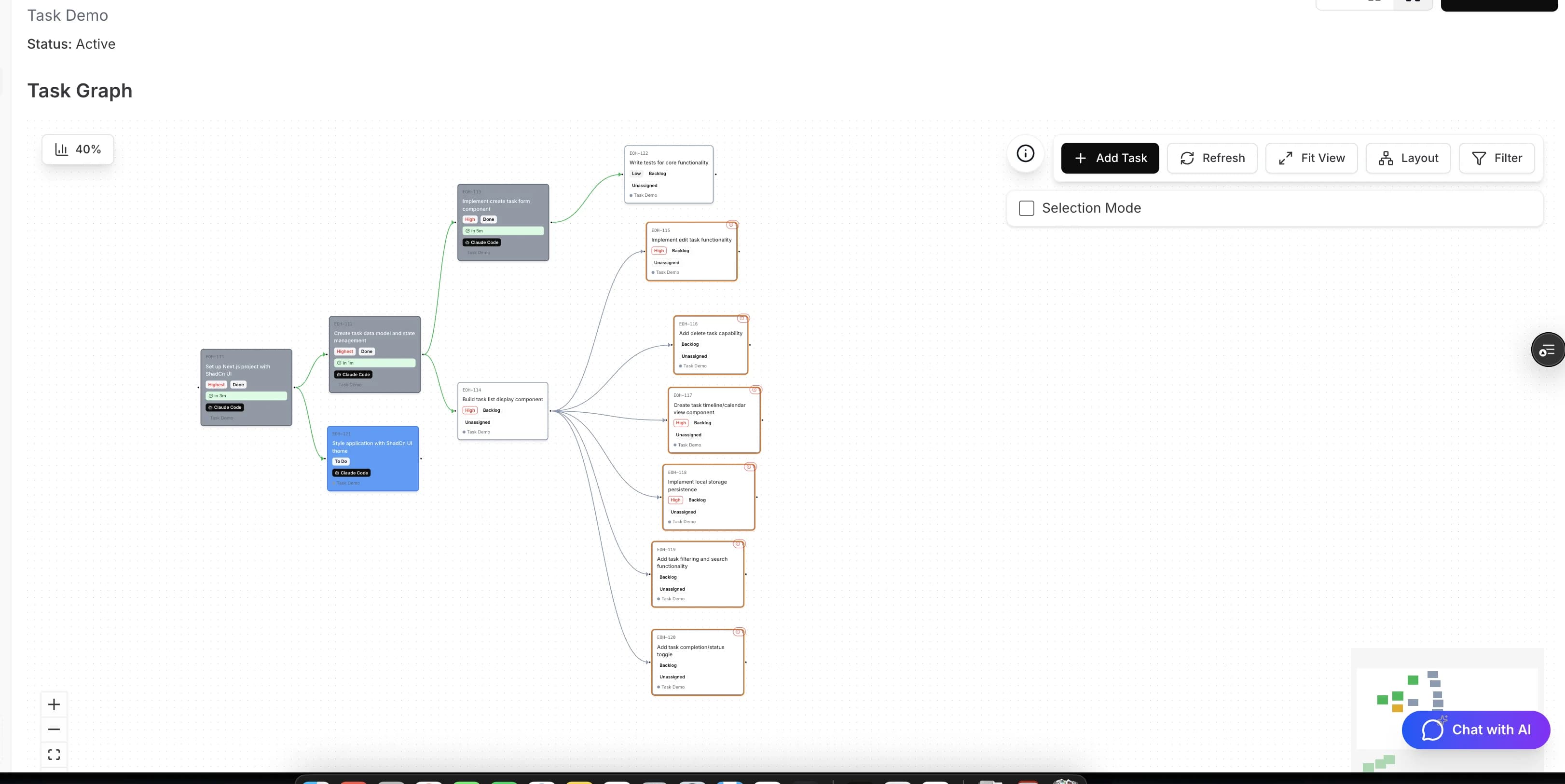
Tasks become an execution graph rather than a static list.
5. Git-Native Integration
Agents operate through controlled Git workflows:
- Automated branch creation
- Isolated commits
- Structured pull requests
- Consistent naming conventions
- Clear PR summaries
This provides the safety teams need for agent automation.
Why Now?
AI coding is no longer experimental. Engineers use Claude Code, Cursor, Aider, and similar tools daily in production.
But productivity plateaus because:
AI writes code quickly. Humans still manage the work manually.
The bottleneck has shifted from writing code to organizing work.
The next productivity leap won't come from faster models alone. It will come from AI-first workflow infrastructure.
The Future: AI as a Team Member
In the near future:
- A goal is defined once
- AI breaks it into structured tasks
- AI plans the execution strategy
- AI completes tasks with proper context
- AI submits pull requests
- Humans review, guide, and shape architecture
This isn't science fiction—it's the workflow we're building into AnyTask.
Software teams won't replace engineers. They'll amplify them with autonomous, structured, predictable AI execution pipelines.
We Need a New Category
Just like GitHub created the category of developer collaboration, and Linear created fast issue tracking, we now need:
AI-Native Task Management
A system where:
- Tasks are machine-readable
- Context is consistently structured
- Attempts and reasoning persist
- Agents execute safely and autonomously
- Humans and AI collaborate seamlessly
This is the foundation we're building at AnyTask.
The tools we use shape how we work. As AI agents become capable teammates, our task management systems must evolve to support both human creativity and machine execution.
The future of productivity lies not in replacing engineers, but in empowering them with systems designed for human-AI collaboration from day one.